Maximizing Soft Signage and Mesh Printing: How K-Print 2026 Validated Dual-Head Sublimation Solutions
Maximizing Soft Signage and Mesh Printing: How K-Print 2026 Validated Dual-Head Sublimation Solutions
From high-visibility outdoor advertising banners to stadium mesh barriers and teardrop promotional flags, the soft signage sector is undergoing rapid global expansion. However, commercial sign makers constantly struggle with double-sided color vibrancy, weatherproofing, and substrate stretch distortion.
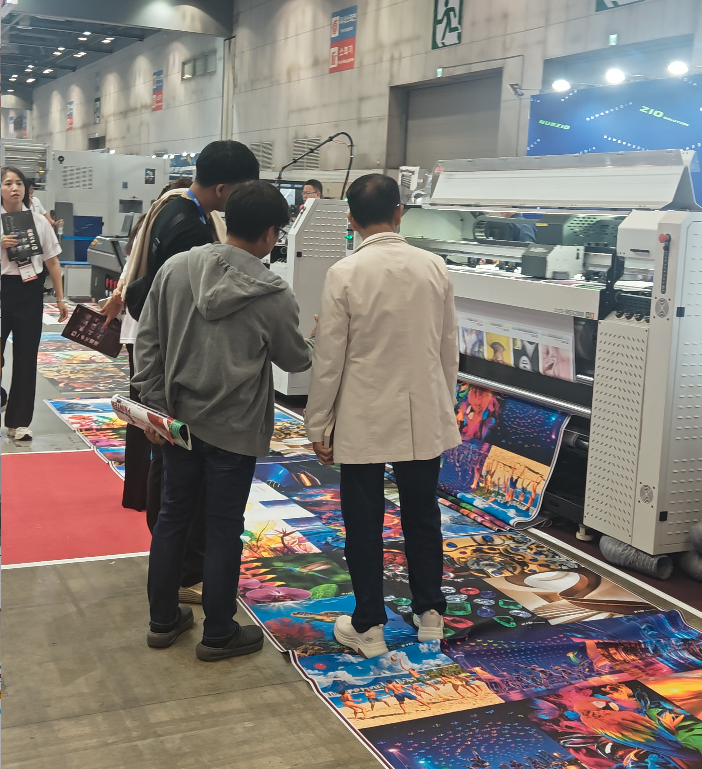
At K-Print 2026, our live production booth demonstrated how the latest dye sublimation dual spray printer and complementary industrial UV Printer systems solve these real-world manufacturing challenges.
The Commercial Challenge: Difficult Substrates in Soft Signage
Modern promotional visual displays demand materials that withstand dynamic outdoor environments. Printing on these textiles presents distinct engineering hurdles:
[ Traditional Single-Head Defect ]       [ Synchronized Dual-Spray Breakthrough ]
   Front: Vibrant Sublimation                 Front: 100% Saturated Chroma
   -------------------------                 -------------------------
   Back:  Faded (40% White-out)               Back:  95%+ Full Density Penetration
- Porous Mesh Fabrics: Perforated wind-resistant banners let airflow pass through, but traditional printing leads to uneven ink distribution and severe bleed-through on the back surface.
- Heavyweight Backlit Banners: High-thread-density polyester lightboxes require saturated color density to prevent washout when illuminated by high-output LED arrays.
- Double-Sided Flags: Double-sided flags require 95%+ image clarity on the reverse side without running costly double-print manual processes.
Material & Process Blueprint: The Industrial Textile Sublimation Printing Solution
To conquer these demanding commercial applications, our end-to-end textile sublimation printing solution incorporates specific hardware-to-chemistry calibrations:
+-------------------------------------------------------------------------+
|                  High-Capacity Soft Signage Workflow                    |
|                                                                         |
|  [ Rip Software Color Mapping ] -> [ Tensioned Media Feeding ]          |
|                                      |                                  |
|  [ Infrared Auto-Drying Array ] <- [ Synchronized Dual-Head Jetting ]   |
|           |                                                             |
|  [ Heat Calender Fixation @ 210°C ] -> [ UV-Stable Soft Signage Finish] |
+-------------------------------------------------------------------------+
1. High-Density Micro-Dot Sublimation Chemistry
Our custom-formulated aqueous sublimation inks feature ultra-fine dye particles suspended in a thermodynamic carrier fluid. When transferred under calender heat (200°C–215°C), the dye molecules bond directly with synthetic polymer chains, creating permanent, UV-resistant pigments.
2. Synchronized Spraying for Superior Penetration
By deploying a synchronized dual-array print mechanism, our mesh fabric sublimation printing process applies micro-droplets in dynamic overlapping sequences. This technique forces ink droplets through perforated openings, delivering crisp visuals on open-weave textiles without messy ink buildup.
Case Study: Upgrading a Large-Scale Signage Producer in Busan
During the K-Print exhibition, a prominent signage manufacturer operating out of Busan, South Korea, formalized an order for three dual-head sublimation lines following an extensive evaluation of their production bottlenecks.
The Operational Challenge
The client had been producing over 120,000 square meters of stadium branding banners per year using legacy plotters. They were facing:
- High scrap rates (14%) due to paper skewing on long continuous runs.
- Inconsistent black density on large outdoor backlit box displays.
- Delivery bottlenecks during peak sports event seasons.
Implementation and Operational Results
Within 30 days of installing our industrial dye sublimation printer fleet:
[ scrap Rate Reduction ]   14% =======> 0.6%
[ Daily Output Capacity]   400 m² ====> 1,200 m²
[ Color Consistency ΔE ]   3.8 ======> 0.9 (Industry Leading)
- Output Tripled: Average daily printing capacity surged from 400 m² to over 1,200 m² per shift.
- Scrap Rate Plummeted: The integrated vacuum transport system and continuous automatic media alignment reduced material scrap to under 0.6%.
- Flawless Color Consistency: Spectrophotometer readings confirmed a Delta E (<1.0) color variance across 500-meter continuous fabric rolls.
Best Practices for Maintenance and Longevity
To ensure maximum uptime and consistent printhead performance under heavy industrial schedules, we advise adhering to standard operating protocols:
- Automated Capping and Flushing: Utilize the automated moisturizing cap station during idle periods to prevent ink dehydration on the nozzle faceplate.
- Controlled Room Environment: Maintain the production floor at 20°C–26°C with 45%–65% relative humidity to eliminate static discharge and prevent paper warping.
- Daily Wiper Blade Cleaning: Clean the polyurethane wiper blade with dedicated cleaning solution at the end of each shift to prevent residue accumulation.
Frequently Asked Questions (FAQ)
Q1: Can this dual-spray sublimation machine print directly onto fabrics without transfer paper?
A: While the machine is optimized for ultra-thin transfer paper for peak sharpness, it can be configured with an optional direct-to-textile mesh collection trough for direct flag and mesh polyester printing.
Q2: How does the output hold up under harsh outdoor conditions?
A: Sublimated polyester textiles exhibit exceptional weather resistance. Because the colorant fuses into the synthetic fibers at the molecular level, graphics resist fading, water damage, and cracking for 12 to 24 months outdoors.
Q3: What complementary benefits does integrating a double sided UV printer provide?
A: Deploying a double sided UV printer alongside sublimation lines lets signage shops supply matching rigid panels (acrylic signs, PVC Foam, aluminum boards) alongside soft fabric installations under unified brand colors.
Q4: Which RIP software packages are compatible with this equipment?
A: The print system integrates with industry-standard RIP engines, including Caldera, Photoprint, Ergosoft, and Onyx, allowing complete ICC profile customization and precise spot color matching.
Q5: How quickly can operators become proficient in running the machine?
A: Thanks to an intuitive touchscreen PLC interface and automated printhead calibration routines, operators can manage routine jobs and daily maintenance within 48 hours of initial training.
Summary
The enthusiastic response at K-Print 2026 highlights the sign industry’s demand for high-capacity, dependable equipment. By upgrading to a high-performance dye sublimation dual spray printer, soft signage manufacturers can tackle tricky fabrics, increase daily production, and deliver premium visual results with rock-solid consistency.