4-Color vs 8-Color Sublimation Printer Applications: Industrial Solutions for Textile Businesses
Different Markets Need Different Printing Strategies
In the modern textile printing industry, equipment selection is no longer simply about purchasing the fastest machine or the printer with the highest number of colors.
Successful manufacturers understand one principle:
The best printing equipment is the one that matches the application, customer expectations, and production model.
A company producing thousands of outdoor flags every month has completely different requirements from a company creating premium decorative fabrics.
This is why the comparison between 4-color and 8-color systems has become increasingly important.
A professional sublimation printer must balance:
- Production speed
- Color performance
- Material compatibility
- Machine reliability
- Long-term operating cost
For industrial users, choosing between a 4-color and 8-color configuration is not only a technical decision but also a business strategy.
Application Scenario 1: Advertising Flag Production Requires Speed and Stability
The advertising flag market is one of the largest applications for sublimation printing technology.
Products include:
- Beach flags
- Sports flags
- Outdoor banners
- Event flags
- Promotional displays
These products share common characteristics:
- Large production volume
- Short delivery deadlines
- Strong demand fluctuations
During major events, exhibitions, or promotional campaigns, manufacturers may receive thousands of meters of orders within a short period.
In this environment, production efficiency becomes the key factor.
A dual head sublimation printer with synchronized printing technology provides advantages through:
- Higher production capacity
- Faster order completion
- Better production scheduling
For standard flag production, a 4-color configuration is often an efficient choice because:
- CMYK is sufficient for most commercial designs
- Color management is easier
- Production speed can be optimized
- Operating costs remain competitive
A company focused on volume production usually benefits more from a stable industrial dye sublimation printer than from additional color channels that may not significantly increase order value.
Application Scenario 2: Exhibition Graphics Demand Maximum Visual Impact
Exhibition and brand display industries operate differently.
Customers are not only purchasing printed fabric.
They are purchasing:
- Brand image
- Visual impact
- Premium presentation
Applications include:
- Exhibition booths
- Backlit displays
- Retail decoration
- Luxury brand events
For these applications, color accuracy becomes extremely important.
A small difference in:
- Corporate colors
- Product images
- Gradient transitions
can directly affect customer satisfaction.
This is where 8-color technology provides additional value.
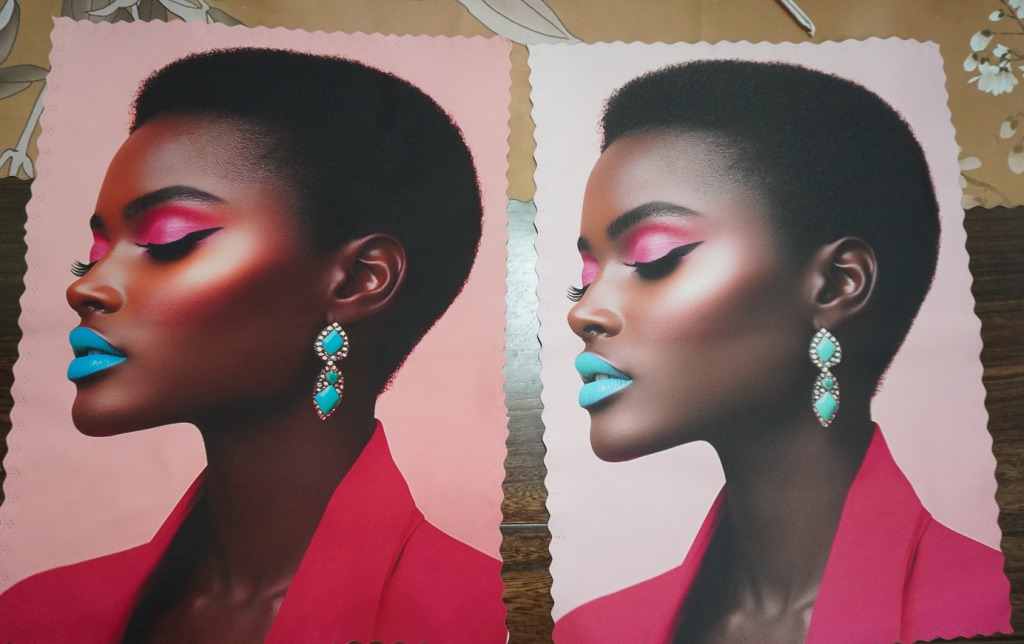
By expanding the color range, an 8-color system can achieve:
- Smoother gradients
- Better shadow details
- More natural skin tones
- Improved color transitions
For premium display production, a high-quality Epson I3200 sublimation printer configuration combined with advanced color management helps manufacturers deliver more consistent results.
Application Scenario 3: Mesh Fabric Printing Requires Precise Ink Control
Mesh fabrics are widely used in:
- Outdoor advertising
- Architectural banners
- Large-area displays
However, mesh structures create unique printing challenges.
Because the fabric contains thousands of small openings, the printing system must control:
- Ink placement accuracy
- Color density
- Drying performance
A professional mesh fabric sublimation printing solution requires stable ink delivery and precise mechanical control.
For manufacturers producing mesh materials, important equipment features include:
High-Precision Printhead Technology
Industrial printheads such as Epson I3200 provide:
- Accurate droplet placement
- Stable image quality
- Reliable production performance
Dual Head Technology
A dual head sublimation printer can increase productivity while maintaining image consistency.
Stable Mechanical Structure
Long-term industrial printing requires:
- Accurate feeding system
- Stable carriage movement
- Reliable heating control
Without mechanical stability, even excellent ink technology cannot achieve consistent production.
Application Scenario 4: High-End Textile Products Focus on Color Value
Some textile businesses compete through product differentiation rather than production volume.
Examples include:
- Fashion fabrics
- Premium home textiles
- Decorative curtains
- Customized textile products
For these markets, customers often compare suppliers based on:
“Who can reproduce the design better?”
rather than:
“Who can print faster?”
An 8-color system provides advantages when producing:
- Complex patterns
- Artistic designs
- Photographic images
- Multi-tone gradients
The additional color channels help create a more refined visual effect.
For companies targeting premium customers, color performance can increase product pricing and improve profit margins.
Production Reliability: The Hidden Factor Behind Equipment Selection
Many buyers focus on specifications but overlook one critical factor:
Machine reliability.
A printer installed in a factory must handle:
- Daily continuous operation
- Different fabric types
- Changing order requirements
- Long production cycles
Professional manufacturers evaluate:
High Load Production Testing
Industrial equipment should be tested under realistic production conditions.
Important indicators include:
- Printing consistency
- Color stability
- Mechanical durability
- Maintenance frequency
Maintenance Cost
A reliable machine reduces:
- Operator adjustment time
- Production interruptions
- Unexpected service costs
This directly improves business profitability.
Case Study: How Different Businesses Choose Their Printing Systems
Case 1: Flag Factory Expanding Production Capacity
Business model:
- 80% outdoor flags
- 20% banners
Main requirements:
- Fast delivery
- Large daily output
- Stable operation
Solution:
4-color dual spray system.
Business result:
The company improves production efficiency and handles more daily orders without increasing labor requirements.
Case 2: Exhibition Supplier Targeting Premium Customers
Business model:
- Exhibition graphics
- Brand displays
- Customized fabric decoration
Main requirements:
- Premium appearance
- Accurate colors
- Higher product value
Solution:
8-color sublimation printing system.
Business result:
The company can provide higher-end products and compete for more profitable projects.
Case 3: Integrated Textile Printing Company
Business model:
- Advertising orders
- Textile customization
- Exhibition projects
Solution:
Combination strategy:
4-color equipment handles regular production.
8-color equipment handles premium applications.
This creates a balanced production ecosystem.
Why UV Printing Technology Also Matters in Modern Digital Production
Although sublimation dominates polyester textile applications, many manufacturers also require rigid material printing solutions.
For example:
- Acrylic panels
- Wood boards
- Glass
- Metal products
A professional UV Printer provides complementary capabilities.
Modern industrial printing companies often combine:
- Sublimation systems for textile applications
- UV printing systems for rigid materials
This creates a complete digital printing workflow.
Advanced configurations such as dual head UV Printer technology can improve production efficiency for companies handling diverse applications.
How to Build the Right Printing Solution for Your Business
Before purchasing equipment, companies should analyze:
Product Structure
What percentage of your business comes from:
- Flags?
- Textile products?
- Exhibition graphics?
- Customized orders?
Customer Requirements
Do customers prioritize:
- Faster delivery?
or:
- Better visual quality?
Future Growth
Will your business expand into:
- Premium textile markets?
- International orders?
- Custom production?
The answers determine whether a 4-color or 8-color system provides better long-term value.
FAQ: Industrial Applications of 4-Color and 8-Color Sublimation Printing
1. Is 4-color printing enough for outdoor flag production?
Yes. Most commercial flag production can achieve excellent results with a professional 4-color industrial system.
2. Why do exhibition companies prefer 8-color printing?
Because exhibitions rely heavily on visual presentation, and expanded color capability improves image quality.
3. Can sublimation printers print mesh fabrics?
Yes. With the correct settings and a professional mesh fabric sublimation printing solution, mesh materials can achieve stable results.
4. What is the advantage of dual spray technology?
Dual spray technology improves production efficiency and supports continuous industrial printing.
5. How does Epson I3200 technology improve printing?
It provides precise ink control, stable output, and suitability for long production cycles.
6. Should a growing factory buy 4-color or 8-color equipment?
It depends on the order structure. High-volume businesses usually benefit from 4-color systems, while premium markets benefit from 8-color systems.
7. Can sublimation and UV printing equipment work together?
Yes. Many modern printing companies combine sublimation systems and UV Printer solutions to cover textile and rigid material applications.
Conclusion: Match Technology With Market Demand
The future of industrial digital printing is not about choosing the most expensive machine.
It is about choosing the right technology for the right application.
4-color sublimation systems help manufacturers win through:
- Speed
- Efficiency
- Production capacity
8-color systems help manufacturers win through:
- Color accuracy
- Premium applications
- Higher product value
For companies building long-term competitiveness, the ideal textile sublimation printing solution is the one that improves production efficiency while creating more valuable products.
The smartest manufacturers do not simply buy printing equipment.
They invest in a complete production strategy.