
How to Choose a Dye Sublimation Dual Spray Printer for Profitable Industrial Production
The Right Printer Should Be Evaluated as a Production Asset
For a textile printer, advertising manufacturer, or signage company, purchasing an industrial printing machine is not simply a matter of finding the lowest quotation.
The real investment question is:
How much production value can this machine create over the next three to five years?
That changes the way an overseas buyer should evaluate a dye sublimation dual spray printer.
Instead of looking only at machine price and advertised printing speed, procurement teams should examine the complete production equation:
- Output capacity
- Double-sided printing capability
- Color consistency
- Labor requirements
- Material waste
- Maintenance cost
- Machine reliability
- Technical support
- Product selling price
- Expected utilization
For companies producing flags, banners, exhibition graphics, mesh textiles, sportswear, or customized polyester fabrics, these factors can have a much greater impact on profitability than the initial equipment price.
Hanzer focuses on industrial sublimation and UV Printer technology, providing printing equipment, inks, and customized consumable solutions for businesses looking to build or upgrade their digital printing production.
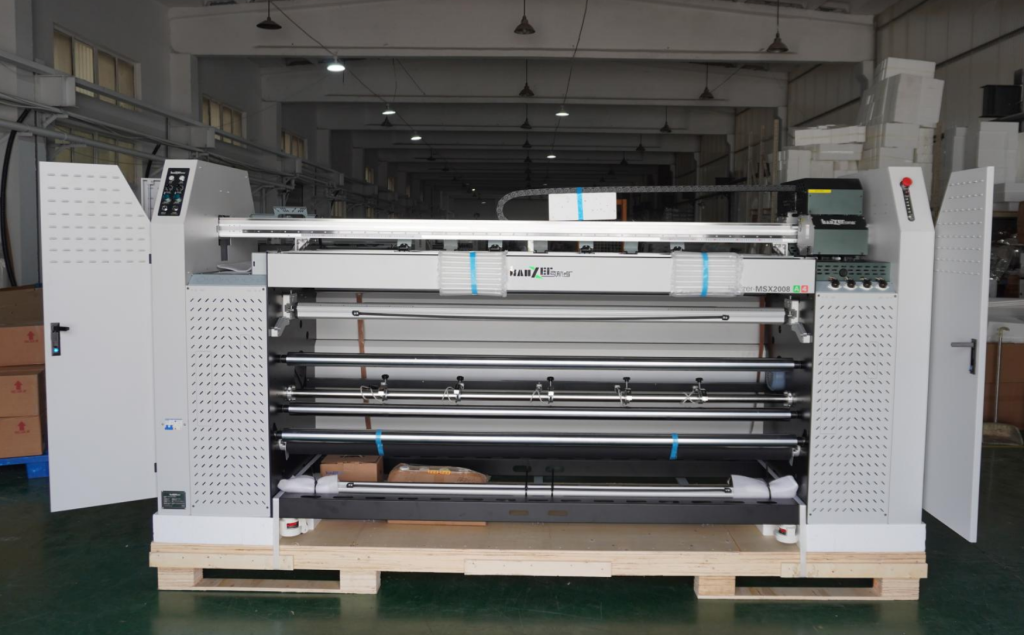
Step 1: Decide Whether Your Business Actually Needs Dual-Sided Printing
The first purchasing mistake is choosing a machine before defining the production requirement.
If your business primarily produces conventional single-sided textile graphics, a standard sublimation printer may already meet your needs.
But the situation changes when double-sided products represent a significant part of your business.
Typical applications include:
- Advertising flags
- Event flags
- Sports banners
- Double-sided displays
- Exhibition graphics
- Semi-transparent decorative textiles
- Specialized promotional fabrics
In these applications, printing the two sides separately creates additional production steps.
A typical workflow becomes:
First-side printing → fabric handling → repositioning → second-side printing → alignment inspection
Every additional operation consumes time and labor.
A dual-spray configuration is designed to simplify this workflow through synchronized printing.
Step 2: Understand What Dual Spray Technology Actually Changes
The term “dual spray” should not simply be interpreted as “two printheads.”
For an industrial buyer, the important question is how the complete system coordinates:
- Printhead movement
- Ink delivery
- Material feeding
- Front/back registration
- Printing parameters
- Color management
The objective is to maintain stable printing on both sides while keeping the production process efficient.
A properly engineered dual head sublimation printer can provide several practical advantages.
Less manual handling
Operators spend less time flipping and repositioning material.
Better production continuity
The workflow is more suitable for commercial orders requiring repeated output.
More efficient double-sided production
The machine can be used for products where both sides have visual value.
Flexible production modes
A dual-sided machine does not necessarily mean that every job must be printed on both sides.
For applications requiring only one printed side, the equipment can switch to single-sided printing.
This flexibility is important because factory orders rarely remain identical throughout the year.
Step 3: Don’t Buy Based on Maximum Speed Alone
“Maximum speed” is one of the most commonly advertised specifications in the printing industry.
However, maximum speed and profitable production speed are not necessarily the same.
Suppose a machine reaches a very high speed under ideal test conditions but requires frequent adjustments, cleaning, or operator intervention.
The theoretical number may look impressive.
The actual factory output may not be.
For procurement purposes, buyers should ask suppliers for information about:
- Long-run production tests
- Typical production speed
- Print quality at different speed levels
- Continuous feeding performance
- Color consistency
- Downtime
- Maintenance intervals
An industrial dye sublimation printer should be evaluated according to its ability to maintain consistent production—not just its highest laboratory or demonstration speed.
Step 4: Printhead Selection Matters, but the Complete System Matters More
Printhead technology is another important consideration.
Hanzer equipment can be configured with Epson I3200 printhead technology. An Epson I3200 sublimation printer configuration can provide precise droplet control, fine image detail, smooth gradients, and high-resolution output.
But experienced buyers should avoid evaluating a printhead separately from the machine.
The printhead is only one part of the production system.
The final result also depends on:
- Ink system design
- Printhead control
- Mechanical accuracy
- Software
- Color profiles
- Fabric characteristics
- Heating process
- Operator settings
A high-quality printhead installed in an unstable machine does not automatically create a high-quality production line.
The correct evaluation is always:
Printhead + machine structure + ink + software + process + technical support.
Step 5: Use Your Own Fabric for the Acceptance Test
This is one of the most important recommendations for international buyers.
Do not make a purchasing decision based entirely on samples supplied by the manufacturer.
Send the supplier the actual materials you intend to use.
For example:
- Flag fabric
- Mesh fabric
- Polyester textile
- Exhibition fabric
- Lightweight fabric
- Semi-transparent material
Ask the supplier to print your own artwork.
This allows you to evaluate the complete textile sublimation printing solution under realistic conditions.
The test should examine:
Image quality
Are small text and fine details clear?
Gradient performance
Are color transitions smooth?
Color accuracy
Can the machine reproduce your required brand colors?
Ink penetration
Does the print achieve the required visual effect after sublimation?
Registration
Are front and back graphics positioned accurately?
Production stability
Does quality remain consistent after extended printing?
A genuine factory test tells you much more than a showroom sample.
Step 6: Calculate ROI Before Comparing Machine Prices
A professional procurement department should calculate the machine’s potential return before making the final decision.
A simple model is:
Annual machine benefit = Additional production profit + labor savings + waste reduction − additional operating expenses
Then compare this number with the initial investment.
For example, imagine a factory can generate an additional $2,500 in monthly contribution margin because a new dual-spray system increases its productive capacity.
Annual additional contribution:
$2,500 × 12 = $30,000
If labor savings and reduced waste contribute another $6,000 per year, the total annual benefit becomes:
$36,000
The actual ROI will depend on the company’s utilization and operating costs, but this approach provides a much more realistic purchasing framework.
The important point is that machine price should be compared with earning potential, not viewed in isolation.
Where Dual-Sided Printing Can Create the Biggest Economic Advantage
Not every factory will receive the same ROI from dual-spray technology.
The strongest business case usually appears when the company has high-volume double-sided production.
Advertising flags
Flags are an obvious application because both sides may need to deliver visual information.
A synchronized double-sided workflow can reduce manual handling while helping manufacturers deliver more finished products within the same production schedule.
Sports and event graphics
Large events often involve strict delivery deadlines.
Production capacity becomes particularly valuable when thousands of meters must be completed within a short period.
Exhibition displays
Exhibition suppliers often deal with multiple designs and short turnaround times.
Digital sublimation allows them to move between designs without the preparation requirements associated with traditional printing.
Mesh and specialty textiles
Mesh fabric sublimation printing requires controlled ink application and suitable process parameters.
Before purchasing, buyers should always test their actual mesh material because fabric structure can significantly affect the final result.
Step 7: Consider Long-Term Operating Cost
A printer’s purchase price is paid once.
Maintenance and operating costs continue for years.
This is why a procurement evaluation should include:
| Cost factor | What to evaluate |
|---|---|
| Labor | Operators required per shift |
| Ink | Consumption and actual cost per square meter |
| Fabric waste | Reprints and registration errors |
| Maintenance | Cleaning and preventive maintenance |
| Spare parts | Availability and replacement cost |
| Downtime | Potential production losses |
| Energy | Long-term operating consumption |
| Technical support | Response time and remote assistance |
This approach helps buyers identify the genuinely cost effective sublimation printer for their business.
The cheapest machine is not automatically the lowest-cost machine.
Step 8: Check Whether the Machine Can Handle High-Load Production
Before purchasing an industrial printer, ask for a realistic production demonstration.
Ideally, the test should involve several hours of continuous operation rather than a short sample.
Look for:
- Stable carriage movement
- Consistent nozzle performance
- Uniform color
- Stable fabric feeding
- Reliable ink delivery
- Consistent double-sided registration
- No unexpected interruptions
This is particularly important for companies operating multiple shifts.
A machine that performs consistently under high-load conditions can provide much greater value than one that only produces impressive samples.
Step 9: Don’t Ignore Outdoor Durability
If your main products are flags, banners, or outdoor promotional textiles, color durability must be part of the purchasing evaluation.
Dye sublimation works by transferring dye into suitable synthetic fibers through heat.
This creates a different result from simply placing a layer of ink on the surface.
However, outdoor durability depends on several variables:
- Fabric composition
- Ink formulation
- Ink density
- Heat-transfer parameters
- Exposure to sunlight
- Weather conditions
- Application environment
Therefore, buyers should request application-specific samples and, where relevant, conduct real-world outdoor testing.
For a professional supplier, discussing limitations and testing conditions is more useful than making unrealistic durability promises.
Step 10: Evaluate the Manufacturer, Not Just the Machine
For an overseas buyer, the supplier behind the machine can be just as important as the equipment itself.
Ask:
Does the manufacturer actually understand the application?
A reliable supplier should be able to discuss:
- Which fabric is suitable
- Which ink should be used
- How to configure color profiles
- How to maintain the printhead
- How to diagnose production problems
- How to optimize different applications
Hanzer’s product portfolio covers sublimation printing equipment, UV Printer systems, weak-solvent printing equipment, inks, and customized consumables.
This broader product capability can be useful for businesses that operate multiple digital printing processes.
Rather than treating every application as identical, the goal should be to match the printing technology to the final product.
Why Hanzer Is Worth Considering for an Industrial Printing Upgrade
The strongest reason to choose a manufacturer should not be a slogan.
It should be the combination of technology, application experience, production stability, and long-term support.
For buyers looking for synchronized double-sided production, Hanzer focuses on:
- Dual-spray sublimation technology
- Industrial production capability
- Epson I3200 printhead configurations
- Accurate color reproduction
- Double-sided registration
- Flexible single-sided operation
- Textile and advertising applications
- UV printing solutions
- Ink and consumable support
This makes Hanzer suitable for buyers who are looking beyond a basic entry-level sublimation machine and are planning a more professional production operation.
A Final Checklist Before You Place the Purchase Order
Before signing a machine contract, ask yourself seven questions:
1. Does my business actually need double-sided production?
If yes, dual-spray technology deserves serious consideration.
2. Have I tested my actual fabric?
If not, request a real production test.
3. Have I checked continuous production stability?
Do not rely only on short demonstrations.
4. Have I evaluated color accuracy?
Especially important for corporate and advertising customers.
5. Have I calculated labor and waste savings?
These can significantly influence the actual ROI.
6. Have I investigated after-sales support?
A production machine is only valuable when it can keep producing.
7. Am I comparing total ownership cost rather than purchase price?
This is the key difference between a low-price purchase and a smart industrial investment.
FAQ: Buying a Dual-Spray Sublimation Printer
Q1: Is a dual-spray sublimation printer better than a single-spray printer?
Neither is universally better. A single-spray system may be sufficient for single-sided, lower-volume production. A dual-spray system becomes more attractive when double-sided products, high throughput, and reduced manual handling are important.
Q2: Can a dual-spray machine also print single-sided products?
Depending on the specific machine configuration, yes. A dual-sided production machine can be designed to switch to single-sided printing when the application requires it.
Q3: What should I test before buying an industrial sublimation printer?
Test your actual fabric and artwork. Evaluate color accuracy, gradient quality, registration, ink penetration, production speed, feeding stability, and long-duration operation.
Q4: Is Epson I3200 enough to guarantee good printing quality?
No. The Epson I3200 is an important printhead platform, but final quality also depends on the machine’s mechanical structure, ink system, software, color management, and printing process.
Q5: How do I compare two sublimation printers with different prices?
Calculate total cost of ownership. Compare productivity, labor requirements, ink consumption, maintenance, waste, downtime, technical support, and expected useful life—not just the purchase price.
Q6: Is dual-spray technology suitable for advertising flag production?
Yes. Advertising flags are one of the applications where double-sided production can provide significant workflow benefits, particularly for manufacturers handling commercial-volume orders.
Q7: Should I test mesh fabric before purchasing?
Yes. Mesh structures can behave differently from conventional polyester fabrics. A sample test using your actual material is strongly recommended.
Q8: What makes a sublimation printer cost-effective?
A cost-effective machine should deliver a good balance of purchase price, production capacity, reliability, maintenance cost, labor efficiency, material utilization, and product quality.
Conclusion: Choose the Machine That Supports Your Business Model
For overseas buyers, choosing an industrial sublimation printer should begin with a simple question:
What does my production line need to achieve?
If the business requires high-volume textile production, double-sided advertising graphics, precise color reproduction, and reduced manual handling, a professional dye sublimation dual spray printer can provide a strong foundation for growth.
The best purchasing decision is not necessarily the machine with the lowest price.
It is the machine that can maintain reliable production, control operating costs, support demanding applications, and generate measurable value over its working life.
For manufacturers evaluating both sublimation and UV printing capabilities, Hanzer provides equipment, inks, and customized consumable solutions designed around industrial digital printing applications.
Buy for production. Calculate for ROI. Test before you decide.